


British Berry Growers Calls For ‘Fresh Outlook’ On Food Advertising
British Berry Growers has launched a campaign to extend junk food advertising restrictions to outdoor media and promote healthier eating options as new research finds 91% of children are exposed to unhealthy food messaging on the school run.
The trade association is calling on the government to close a policy “loophole”, saying the current limitations – on advertising foods high in fat, salt and sugar (HFSS) on television before 9pm and through paid online channels – “do not go far enough” to protect children.
British Berry Growers (BBG) said in a press release that is urging the government to introduce equivalent restrictions for out-of-home (OOH) advertising, such as bus shelters, billboards, and digital screens.
Its calls include a proposed ban on HFSS advertisements appearing within 400 metres of school entrances.
BBG’s ‘Fresh Outlook on Food’ campaign comes months after new regulations restricting unhealthy food and drink product advertising on television before 9pm and through paid online channels took effect.
While those measures were widely welcomed by public health advocates, campaigners arguing that OOH advertising remains a significant gap in the UK's efforts to improve children's diets.
“The rules have changed online and on television, but the moment children step outside, the old rules still apply,” pointed out Nick Marston, Chair of British Berry Growers, the trade body that represents 95% of soft fruit growers in the UK.
“We’ve made real progress in restricting junk food advertising, but there’s still an obvious loophole that needs closing. We’re calling for a fresh outlook on food advertising. Children are surrounded by marketing for fast food and HFSS products, while healthy foods such as berries are almost invisible in the outdoor advertising landscape.
“Foods like berries are packed with fibre, vitamins and antioxidants and can play an important role in a healthy, balanced diet. Children deserve to see more of those positive food choices promoted in the places they live, learn and travel through every day,” Marston continued.
“If the Government believes children should be protected from HFSS advertising on screens, the same principle should apply on our streets.”

Research Highlights Parental Concerns
New consumer research, commissioned by BGG, found that 91% of parents believe their children are exposed to junk food advertising during the school run.
The study also found that 74% of parents support extending HFSS advertising restrictions to outdoor environments.
According to the research, concern among parents is widespread.
Three in five respondents said they worry about their child's exposure to junk food advertising, while 60% believe such marketing actively undermines healthy eating habits established at home.
The influence of advertising on children's food requests was also highlighted, with 87% of parents reporting that their child has asked for junk food after seeing it advertised.
Around half of those parents said such requests occur several times each week.
Outdoor Advertising Under Increased Scrutiny
The campaign comes amid broader debate about the role of advertising in tackling childhood obesity and improving public health outcomes.
Campaigners argue that while digital and broadcast media are now subject to tighter controls, outdoor advertising remains highly visible and difficult to avoid.
British Berry Growers describes the sector as the "last unregulated frontier" for HFSS marketing.
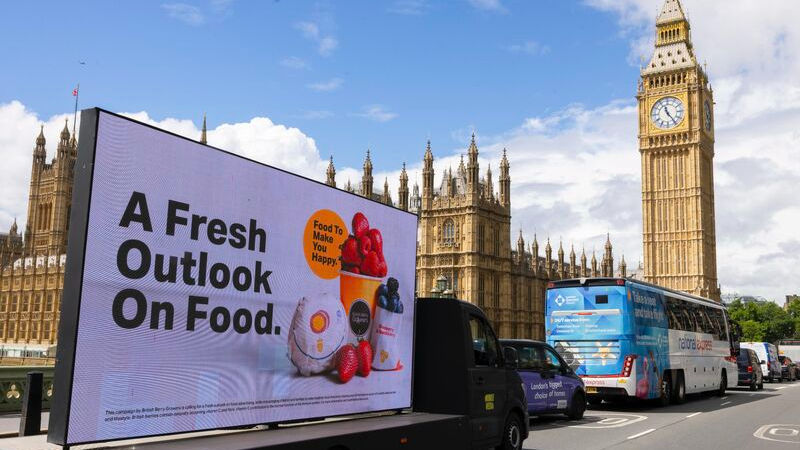
To mark its ‘Fresh Outlook on Food’ campaign launch, BBG installed a series of parody outdoor advertisements modelled on the creative styles commonly associated with major fast-food brands.
Instead of burgers, fries, and fried chicken, the advertisements featured British strawberries, raspberries, blueberries, and blackberries in the same outdoor spaces typically used to promote HFSS products.
The initiative aims to demonstrate how outdoor advertising spaces could be used to promote healthier food choices and increase the visibility of fresh produce.

Public Health Context
The campaign is taking place against a backdrop of continuing concern about childhood obesity rates.
According to Department of Health and Social Care figures cited by BBG, nearly one in four children (24%) are overweight or obese by the time they begin primary school.
Further evidence cited by campaigners comes from youth-led food advocacy organisation Bite Back, which campaigns for healthier school food and fairer advertising.
Its recent research found that 35% of schools have at least one HFSS advertisement within 400 metres of their gates.
The report also highlighted disparities in advertising exposure, finding that fast-food advertising appeared significantly more frequently in more deprived communities than in affluent areas.
Industry and Advocacy Support
The Fresh Outlook on Food campaign has attracted support from broadcaster and Food Unwrapped presenter Kate Quilton, who said parents often struggle to compete with the volume of food marketing children encounter in everyday environments.
“Parents are trying their best, but we’re competing with powerful marketing messages everywhere our children go,” she noted.
Meanwhile, former Youth MP and Bite Back founding youth board member Dev Sharma said the government's recent HFSS advertising reforms represented an important step forward but argued that outdoor advertising should now be addressed as the next stage of policy development.
"The rules for TV screens should now apply to the streets,” Sharma urged. “At the very least local and combined authorities should use their existing powers – the same powers Transport for London used to introduce HFSS advertising restrictions across its estate in 2019 – to act now on the assets they own and control.”
As policymakers continue to evaluate the impact of the UK's HFSS advertising reforms, campaigners are increasingly turning their attention to the role of outdoor media and whether further restrictions could form part of future public health policy.
For the OOH sector, the debate raises questions about the balance between commercial freedom, public health objectives and the evolving expectations placed on advertising environments frequented by children and families.
Comments